

What Makes a Rancho Santa Fe Estate Truly Worth Buying?
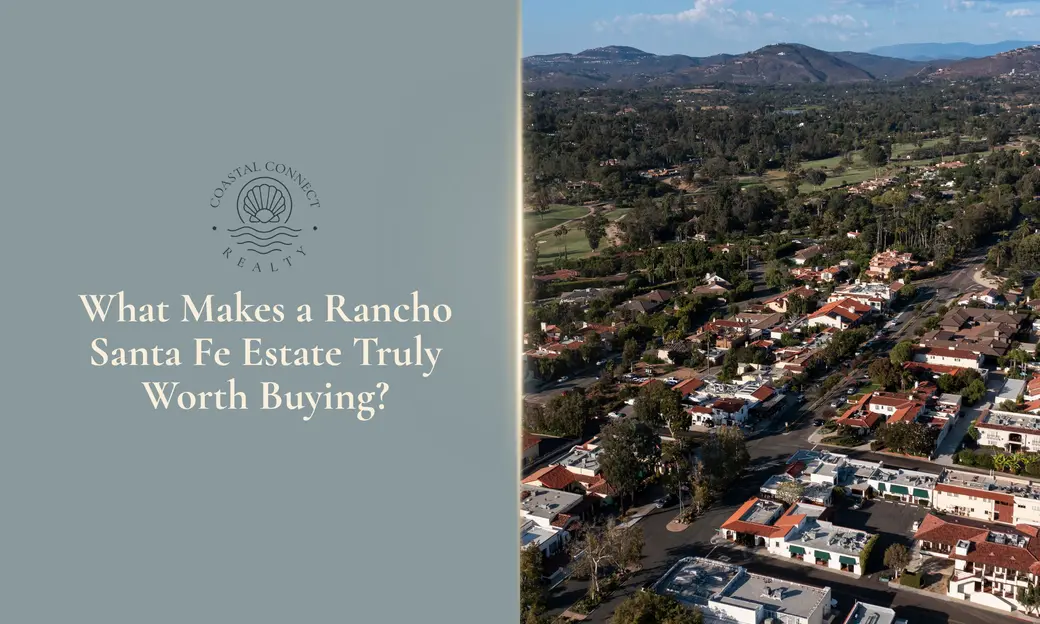
A Rancho Santa Fe estate can look perfect online.
Beautiful house. Huge lot. Privacy. Pool. Mature landscaping. Maybe a guest house, tennis court, or incredible views.
But when you're buying at this level, I don't want you to stop at what the property has.
I want you to ask what the property allows, supports, and makes difficult to change.
Because with an estate, you're not just buying the house. You're buying the land, the surroundings, the systems, the restrictions, and everything that comes with maintaining a much larger property.
Here are seven things I'd investigate before getting serious about an estate in Rancho Santa Fe.
1. Is the lot actually usable?
A large lot sounds great.
But acreage and usable acreage are not the same thing.
Look at the topography. Where is the house sitting? How much of the property is relatively level? Where are the driveways, slopes, landscaping, pools, courts, guest structures, and other improvements?
If you're buying an estate because you want room for horses, entertaining, recreation, an additional structure, or simply more usable outdoor space, don't assume the lot size tells you what you can actually do.
The Rancho Santa Fe Association's current application requirements call for detailed information about existing and proposed structures, property lines, easements, setbacks, and, when applicable, grading and topography.
That's a good reminder: look at the land, not just the acreage number.
2. Privacy is about the neighboring properties, too
One of the reasons buyers are drawn to Rancho Santa Fe is privacy.
So I would spend a lot of time looking beyond the property line.
What's next door?
Where are the neighboring homes positioned? Are there properties behind you? Could landscaping change the view? Is there a road, trail, open space, or other feature nearby?
A property can feel incredibly private during a showing and feel very different once you understand the surrounding parcels.
This is especially important if privacy is one of the main reasons you're paying a premium for an estate.
Don't just ask, "How private is it today?"
Ask, "What could change around me?"
3. Find out whether the property is actually in the Rancho Santa Fe Covenant
This is a big one.
People often use "Rancho Santa Fe" and "the Covenant" interchangeably, but if you're buying here, you want to understand the property's actual status and governing documents.
The Rancho Santa Fe Association administers the Protective Covenant, which regulates land use across Covenant properties. The Association also has its own building and planning functions and an Art Jury that reviews development and building applications.
And these aren't minor details.
The Association's own residential guidelines explain that Covenant restrictions can affect architectural style, siting, landscaping, structure size and massing, accessory uses, and even exterior colors.
If you are buying an estate with plans to remodel it extensively, I would want to understand those rules before assuming your renovation ideas are possible.
4. Don't assume you can change the house just because you can afford to
This is one of the biggest differences between buying an ordinary house and buying a property with significant land and community restrictions.
Maybe you're thinking:
"I'll buy this older estate and completely transform it."
Maybe.
But before you build that plan around the property, investigate what approvals are required.
The Rancho Santa Fe Association states that exterior changes are reviewed by the Art Jury and Building & Planning Department, and its current application process includes specific requirements for construction and land-use changes.
The Association's guidelines also specifically caution buyers who intend to build, remodel, expand, subdivide, or change land use to investigate those issues before purchasing.
So if the estate only works for you after a major renovation, that's not a future detail.
That's part of the purchase decision.
5. Investigate the improvements, not just the house
Luxury estates often come with a long list of improvements.
Pool.
Spa.
Guest house.
Outdoor kitchen.
Tennis or sports court.
Large-scale landscaping.
Irrigation.
Equestrian facilities.
Solar.
Retaining walls.
And all of those things need to be evaluated individually.
Were they properly permitted? Who maintains them? How old are they? What will eventually need to be replaced?
The Association's current permitting materials specifically require information on existing and proposed structures, pools and water features, sports courts, easements, solar equipment, grading, and other site details.
A $5 million estate with $5 million worth of future projects is a very different purchase from a $5 million estate that has already had its major systems and improvements thoughtfully maintained.
6. Understand what maintaining the estate actually means
This is the part buyers can underestimate.
A large property doesn't just mean more outdoor space.
It can mean more landscaping, irrigation, trees, pool equipment, gates, roofs, exterior structures, drainage, lighting, and general maintenance.
Rancho Santa Fe is actively focused on water conservation, landscape management, tree maintenance, and fire-safe practices. The Association also maintains rules covering areas such as landscaping, grading, structures, and property maintenance.
So I would want to understand the property's annual operating reality, not just its purchase price.
How much does it cost to maintain the landscaping?
How much help does the property require?
What systems are aging?
What needs attention now?
What will need attention in five years?
Luxury is wonderful.
But luxury with a maintenance list you don't want is not necessarily the right property for you.
7. Ask what would be difficult to change
This might be my favorite question when evaluating an estate.
Forget the easy stuff for a minute.
Paint can change.
Countertops can change.
Fixtures can change.
What can't easily change?
The orientation of the house.
The slope of the property.
The location of neighboring homes.
The road.
The amount of usable land.
The privacy.
Certain setbacks or easements.
The fundamental layout of the site.
The community restrictions.
Those are the things I would pay the most attention to.
Because you can spend a lot of money renovating a property and still not fix the thing you didn't like about it in the first place.
What I would investigate before making an offer
If you're seriously considering a Rancho Santa Fe estate, I'd want to understand these seven things before getting emotionally attached:
- How much of the lot is actually usable?
- What surrounds the property today?
- Could neighboring properties affect your privacy or views?
- Is the property within the Covenant, and what restrictions apply?
- What improvements are permitted and documented?
- What does the property realistically cost to maintain?
- What about the property would be difficult or impossible to change?
The Association itself describes Rancho Santa Fe as a community built around preserving its landscape, architecture, and rural character. That structure is part of what makes the area distinctive, but it also means buyers need to understand the rules before assuming they can do whatever they want with a property.
That is the part I want luxury buyers to understand.
Don't just ask whether you love the estate. Ask whether the estate works for the life you intend to live there.
Because at this level, the most expensive mistake isn't necessarily overpaying.
Sometimes it's buying a property that looks perfect but doesn't give you the flexibility, privacy, usability, or lifestyle you thought you were purchasing.
FAQs
What should luxury buyers investigate before buying an estate in Rancho Santa Fe?
Look beyond the house itself. Investigate the usable land, surrounding properties, privacy, Covenant status and restrictions, existing improvements, maintenance requirements, and what you may or may not be able to change.
What is the Rancho Santa Fe Covenant?
The Protective Covenant is a set of restrictions governing participating properties in Rancho Santa Fe. The Association administers land-use and architectural requirements intended to preserve the community's character and landscape.
Can I remodel an estate in Rancho Santa Fe however I want?
Not necessarily. Covenant properties can be subject to Association and Art Jury review for various construction, architectural, landscaping, and land-use changes. Buyers planning significant improvements should investigate the approval requirements before purchasing.
What should I look for beyond the size of the lot?
Look at topography, usable areas, setbacks, easements, existing improvements, access, neighboring properties, and the location of the home on the land. A large lot does not automatically mean all of the acreage is equally usable.
Is an estate more expensive to maintain than a typical home?
It can be, particularly when the property includes extensive landscaping, pools, multiple structures, mature trees, large outdoor areas, or specialized improvements. The important question is what the specific property requires, not simply how large it is.
About the Author
Marija Peshevska is a REALTOR® with Coastal Connect Realty at Real Brokerage, serving North County San Diego, including Rancho Santa Fe, Carlsbad, Del Mar, Solana Beach, Encinitas, San Marcos, Carmel Valley, and Oceanside. She specializes in relocation and senior and estate transitions. Marija is licensed in California (DRE #02050824) and Florida (SL3627694) and speaks English, Spanish, and Macedonian.
Categories
Recent Posts



Coastal Connect Realty